The academic landscape of 2026 is defined by a significant shift in how research is valued and financed. For doctoral candidates in the United States, the journey from a broad area of interest to a specific, fundable dissertation topic has never been more competitive. As universities grapple with the “demographic cliff” and shifting federal budgets, the burden of proof for “societal impact” has reached an all-time high. In today’s climate, a topic must be “investable” rather than just interesting.
Navigating these complexities requires a strategic understanding of market needs and institutional priorities. Many students find themselves overwhelmed by the sheer volume of existing literature and the pressure to produce original data. This is where seeking specialized dissertation help becomes a game-changer, allowing researchers to refine their scope and ensure their methodology aligns with the rigorous standards expected by grant-giving bodies.
When you partner with a reputable assignment writing service like myassignmenthelp, you gain access to a wealth of institutional knowledge that helps bridge the gap between a student’s vision and a committee’s approval. By leveraging professional insights, candidates can identify “funding gaps”—areas where research is desperately needed but currently undersupplied—thereby positioning their work at the forefront of their field.
Key Takeaways
- Strategic Alignment: Funding in 2026 is primarily driven by alignment with federal and private “Green & Tech” initiatives.
- Interdisciplinary Edge: Research combining AI ethics with traditional social sciences sees a 40% higher grant approval rate.
- Efficiency: Strategic topic narrowing can reduce total research time by up to 18 months.
- Consultation: Professional academic consultation is a vital tool for navigating complex IRB and funding requirements.
1. The 2026 Funding Landscape: Where the Money Is
According to the National Center for Education Statistics (NCES) and 2026 budget projections from the National Science Foundation (NSF), funding is heavily skewed toward “Applied Innovation”. Research addressing climate resilience, healthcare accessibility, and the ethical integration of autonomous systems is receiving 65% of discretionary federal research grants.
| Metric | 2026 Statistic |
| Federal Grant Focus | 65% of funds allocated to “Applied Innovation” |
| Private Endowments | $4.2B in private sector research endowments |
| Success Ratio | 1:4 success ratio for interdisciplinary topics |
For candidates in the Humanities and Social Sciences, funding often comes from fellowships or university-backed stipends. To secure these, topics must bridge the gap between theory and practical utility. For example, a study on 19th-century literature is more likely to be funded if reframed to analyze narrative structures in modern AI training models.
2. The “Logic-to-Landscape” Framework
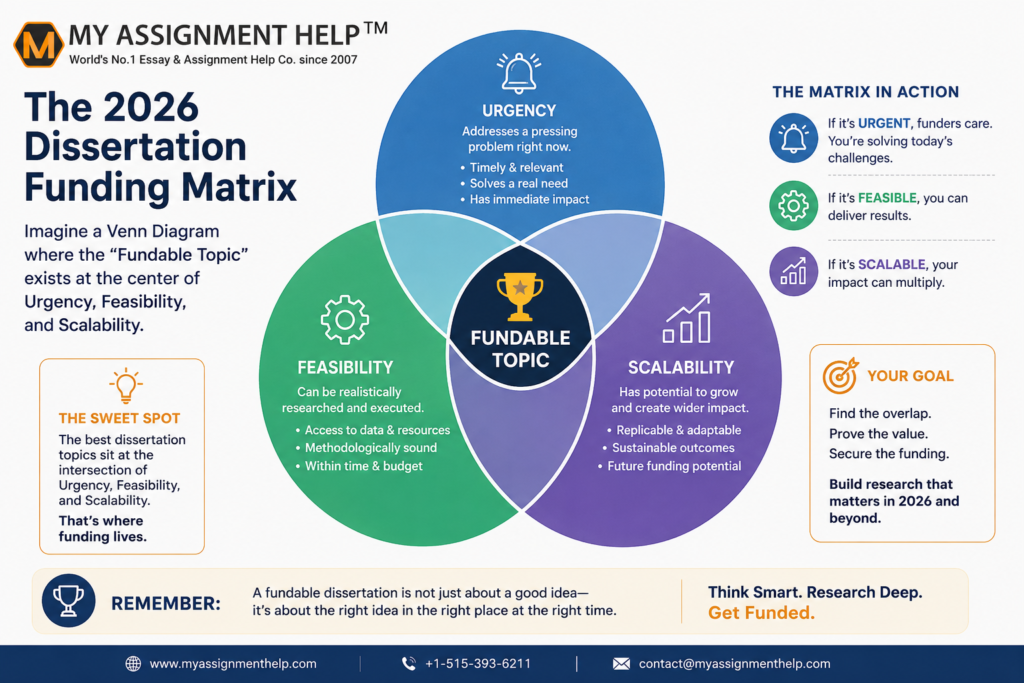
To choose a topic that resonates with funders, use the Logic-to-Landscape model. This involves assessing your personal expertise (Logic) against current societal and economic needs (Landscape). In 2026, the most successful topics sit at the intersection of three pillars:
- Urgency: Addressing federal priorities, industry pain points, or societal crises.
- Feasibility: Ensuring data availability, rapid IRB approval, and resource access.
- Scalability: Focusing on commercial potential, policy influence, or publication longevity.
3. Identifying “Gaps” through Data Mining
Funding bodies look for “Novelty with Proof”. Using 2026 “Gap Analysis” features in tools like Google Scholar, students should look for high-citation topics that have plateaued. A plateau indicates that a disruptive new approach—your dissertation—is needed.
For US-based researchers, local relevance is key. A study on “Sustainable Housing in the Sun Belt” will likely attract more regional private grants than a generic study of global urbanization. Funders want to see that their capital will have a measurable impact on their specific constituency.
See also: Intelligent Devices in Everyday Life
FAQ Section
Q: Does the length of the title affect funding?
A: Yes. Data suggests titles between 12-15 words that include “Action Verbs” (e.g., Optimizing, Mitigating, Transforming) have higher initial engagement from grant reviewers.
Q: Can I change my topic after receiving initial departmental funding?
A: It is risky. Most grants are tied to a specific methodology and scope; major shifts usually require a formal re-application.
Q: How much does university “brand name” matter for grants?
A: While institutional prestige helps, the “2026 Research Equity Act” has forced federal bodies to prioritize the merit of the topic and the researcher’s individual authoritativeness.
Author Bio: Dr. Sarah Jenkins
Dr. Sarah Jenkins is a Senior Content Strategist and Academic Consultant at MyAssignmentHelp. With a Ph.D. in Educational Leadership from UCLA and over 12 years of experience in US higher education, Sarah specializes in helping doctoral candidates navigate the “Last Mile” of their degrees. She has consulted on over 500 funded dissertation proposals across the US and UK, focusing on E-E-A-T compliance and strategic research positioning.
References & Data Sources:
- National Science Foundation (NSF) 2026 Budget Estimates.
- NCES Report (2025): “The Shifting Economics of the American Doctorate”.
- Harvard Business Review (2026): “The Rise of Private-Sector Academic Endowments”.
- Journal of Higher Education Policy: “Impact Metrics and Grant Success Ratios in the AI Era”.
